
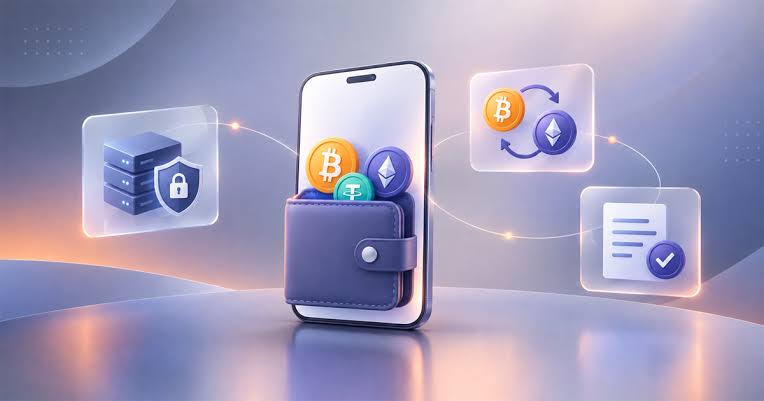
A Wallet Used to Have One Job
For a long time, a crypto wallet had a fairly straightforward purpose: keep your digital assets accessible, allow you to send and receive them and help you manage your private keys.
If you wanted to buy more cryptocurrency, you might need an exchange. If you wanted to swap one token for another, you could visit a decentralised exchange. Staking required finding a supported protocol, while interacting with a decentralised application often meant connecting your wallet to an entirely different website.
That arrangement worked, but it also made crypto feel like a collection of disconnected services. Users had to move between platforms, understand different interfaces and repeatedly connect their wallets to complete simple financial activities.
That experience is gradually changing.
Today's crypto wallets are taking on more responsibilities. Some allow users to purchase crypto with traditional payment methods, swap assets across networks, stake supported tokens, explore decentralised applications and even access more advanced trading products without leaving the app.
The wallet is no longer just where a user keeps their crypto. It is increasingly where they manage what they do with it.
The Industry Is Betting on the Wallet
The shift is becoming visible in the business decisions of major financial and crypto companies.
In April 2026, eToro announced an agreement to acquire Zengo, a self-custodial crypto wallet provider. The transaction was completed in the second quarter, bringing together eToro's multi-asset investing platform and Zengo's wallet technology.
The significance goes beyond another company acquisition. Zengo offers users a self-custodial wallet with features that include token swaps, staking, fiat on-ramps and off-ramps, and access to decentralised applications. These capabilities fit into eToro's broader ambition to connect traditional financial services with on-chain activity.
The deal also highlights a key difference in the wallet market. Self-custody gives users control over their private keys, while a traditional custodial service holds assets on their behalf. Combining a wallet business with a broader investment platform does not automatically mean the two products operate under the same custody model or regulatory arrangements.
For the industry, however, the direction is clear: ownership, access, trading and financial services are increasingly being brought closer together.
From Buying Crypto to Moving Across Networks
One of the biggest changes is the integration of fiat on-ramps and off-ramps.
An on-ramp allows users to purchase cryptocurrency using traditional money through supported payment methods. An off-ramp provides a route to convert crypto into fiat currency. Rather than leaving a wallet to find a separate service, users can access these options within the same interface through integrated payment providers.
This can make the journey from traditional money to digital assets more convenient. However, availability depends on the wallet, the payment provider and the user's country. Fees, exchange rates, identity checks and supported payment methods can also differ.
Swapping is another major part of the transformation. A user holding one cryptocurrency may want to exchange it for another without first transferring funds to a centralised exchange. In-wallet swap services connect users to liquidity providers and decentralised exchanges to facilitate these transactions.
Cross-chain swaps take the idea further by allowing users to move value between supported blockchain networks. This matters because crypto activity is no longer concentrated on a single blockchain. Assets and applications are spread across Ethereum, Solana, BNB Chain, Base and several other networks.
A wallet that can support multiple networks and simplify movement between them reduces the number of platforms users need to navigate. But cross-chain transactions may involve bridges and third-party providers, each introducing its own fees and risks.
Staking and DApps Bring More Finance Into the Wallet
The next layer is the ability to participate in activities that go beyond buying, selling and transferring tokens.
Staking allows holders of supported proof-of-stake assets to participate in network validation, either directly or through a service provider, in exchange for potential rewards. Some wallets make this accessible through a few steps in the app.
Others provide access to decentralised applications, commonly called DApps. These include decentralised exchanges, lending platforms, NFT marketplaces, blockchain games and other Web3 services.
A built-in DApp browser or wallet connection means users can interact with these services without repeatedly moving between unrelated applications. The wallet becomes the point through which they approve transactions and manage access to their assets.
Trust Wallet, for example, presents buying, swapping, staking and Web3 access within one self-custodial platform, with support for more than 100 blockchains. Its browser extension also supports cross-chain swaps and connections to decentralised applications through integrated providers.
This is the appeal of an all-in-one wallet: fewer separate steps, a more connected experience and easier access to different parts of the crypto ecosystem.
Convenience Comes With a Bigger Responsibility
There is a reason this evolution is attractive, but adding more services also creates more decisions for users to make.
A wallet that connects to payment providers, swap services, staking platforms and DApps is interacting with a wider range of third parties and smart contracts. A mistake in one area can have consequences beyond the activity a user originally intended to perform.
A swap may involve unexpected network fees or slippage. A staking product may expose users to lock-up periods, validator risks or changing rewards. A DApp may request permission to spend tokens, and approving a malicious or excessive permission can put funds at risk.
There is also an important difference between having several features in one app and having one company control every part of the service. Some wallets remain non-custodial while relying on external providers for purchases, swaps or other services. Users should understand who processes each transaction, where fees come from and which party is responsible when something goes wrong.
The wallet's growing role does not make basic security practices less important. If anything, it makes them more necessary. Users must still verify applications, review transaction details, protect recovery information and avoid granting permissions they do not understand.
Is the Wallet Becoming the New Financial Dashboard?
The direction of travel suggests that crypto wallets are moving towards something much bigger than digital asset storage. They are becoming interfaces through which users can access payments, investments, trading, decentralised finance and other on-chain services.
That does not mean every wallet will become a financial super app, or that users should abandon specialised platforms. Some will continue to prioritise secure long-term storage, while others will focus on trading, payments or access to particular blockchain ecosystems.
The more likely outcome is a market where wallets offer different combinations of services, allowing users to choose between simplicity, flexibility and advanced functionality.
The challenge for wallet providers will be to make these experiences convenient without making them unnecessarily complicated or compromising security. More features may attract users, but trust will determine whether they stay.
Ultimately, the next generation of crypto wallets will not be judged only by how many assets they can hold. It will also be judged by how easily and safely people can use those assets in the wider digital economy.
When Your Crypto Is Ready to Become Naira
A good financial tool should make moving your money simpler. If you have crypto you want to convert into naira, you don't need another wallet to store it. Monica helps you convert supported cryptocurrencies directly into naira and receive the money in your Nigerian bank account.
Make your next crypto conversion the easy part. Download Monica: https://monica.cash/app