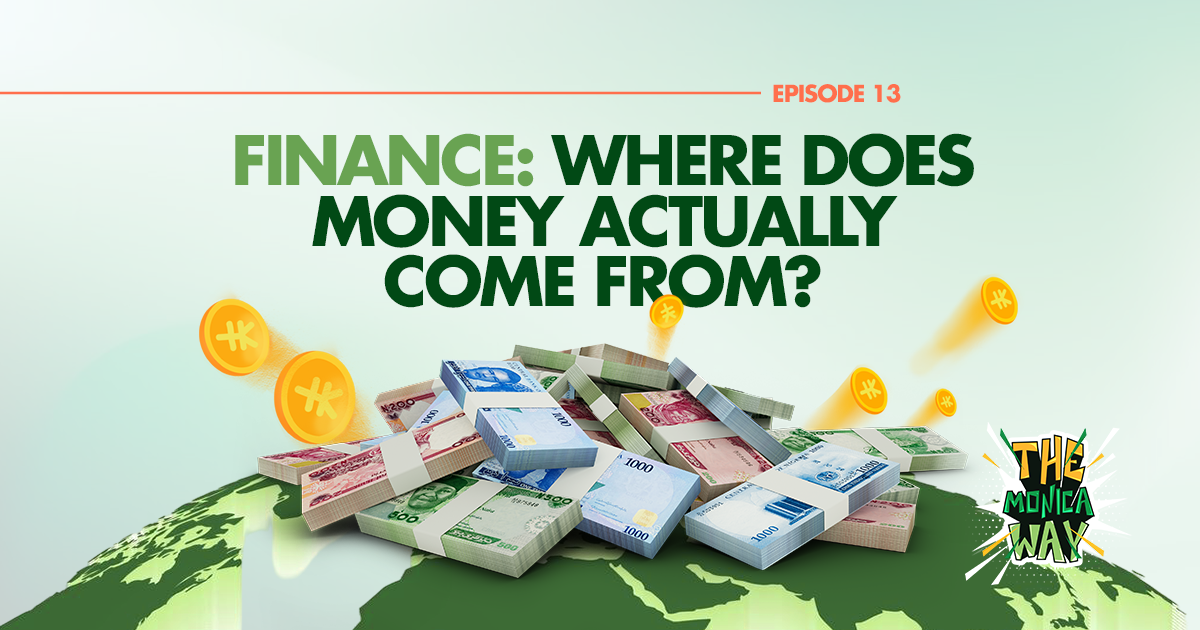
Every currency is a promise. The only real questions are who is making it, and whether you believe them.
Start with a tomato seller.
A woman at a Lagos market takes a ₦1,000 note from a customer, glances at it for half a second and hands back change. She did not test the note. She did not ask what backs it or check the exchange rate that morning. She simply knew the next person she handed it to would accept it.
That half-second glance is the answer to this episode's title. The rest is detail.
Why does a piece of paper buy tomatoes?
Its material is worth almost nothing. A ₦1,000 note costs a tiny fraction of its face value to produce, yet it buys real food, real rent and real airtime.
The value is not in the note. It is in the agreement around it. Everyone accepts it because everyone expects everyone else to accept it. Money is a shared belief that happens to be printed.
Was it always like this?
No, but the belief was always there. Across West Africa, people traded with cowrie shells and, in parts of the south, brass rods called manillas. Nobody needed a central bank to tell them a shell had value. It was scarce, it lasted, it was hard to fake and the next trader would take it.
Later came gold and silver coins, then paper notes that began life as receipts. You deposited gold, got a paper promise to collect it back and found the promise easier to carry than the gold. Governments eventually ran whole currencies this way, with every note exchangeable for a fixed amount of gold.
In August 1971, the United States stopped letting other countries swap dollars for gold, and the system unravelled. Most currencies since then are what economists call fiat money, from the Latin for "let it be done." Money exists because the government says so, and it holds value because enough people believe it will.
So where does money physically come from?
From two places, and neither involves digging anything up.
The central bank issues the notes and the reserves that banks hold. But most of the money in an economy never passes through the printing press. It is created when a commercial bank approves a loan. The bank credits the borrower's account with money that did not exist a moment earlier, and the borrower promises to pay it back.
So most money is a record of who owes what to whom. It works for as long as people trust those promises to be kept.
So what holds up the naira?
Five things, working together.
The law. The naira is legal tender, and the government collects taxes only in naira. Anyone who owes tax needs naira, which keeps demand for it alive.
The central bank. The CBN has issued Nigeria's currency since the Nigerian pound in 1959. The naira replaced the pound in 1973, at two naira to one pound. At launch it was worth more than a US dollar.
The reserves. Nigeria's external reserves now stand above $50 billion. These are not a vault backing each note one for one. They are a buffer that lets the central bank defend the currency when it comes under pressure.
The economy. Oil, gas, farm produce, services and the money Nigerians abroad send home all create demand for naira. A currency is partly a claim on what a country can produce and sell.
The habit of belief. All of the above matters only because people keep accepting the naira. Take that away and the rest cannot save it.
What happens when the belief wobbles?
Zimbabwe printed a 100-trillion-dollar note in 2009. It could not buy a loaf of bread, because nobody trusted the promise anymore.
Nigeria has had a milder version of its own. Between 2023 and 2024, the naira lost roughly more than 0% of its value against the dollar. Salaries looked the same on paper. The tomatoes did not cost the same.
Confidence has been returning since. This week the official rate sits around ₦1,346 to the dollar and the open market around ₦1,390, in a calmer market supported by reserves above $50 billion. Confidence is slow to rebuild and quick to lose, which is why people watch these numbers so closely.
When trust is high, nobody thinks about money. When it falls, everyone becomes an economist overnight.
So why are millions of people holding digital dollars?
Because the naira's rough years made a lot of people ask the old question out loud: who do I trust to keep the value of what I earn?
Stablecoins offered an answer. USDT, now around $180 billion in size, and USDC, around $71 billion, are digital tokens designed to stay at one dollar. They are backed by reserves, largely cash and short-term US government debt. They did not invent a new reason to trust money. They borrowed the dollar's credibility and made it portable, so a digital dollar can cross a border in minutes with no bank in between.
Stablecoins still depend on trust, in the issuer, its reserves and the rules around it. That is why audits and regulation matter so much.
Bitcoin gives a third answer. Its supply is capped at 21 million coins, about 20.1 million of which already exist. No government stands behind it and no reserves back it. Its price swings reflect that.
So the three kinds of money rest on three kinds of trust:
The naira: trust in a government and its central bank.
Stablecoins: trust in reserves and the company holding them.
Bitcoin: trust in code and scarcity.
Where does Monica fit?
Monica is not a new kind of money, and it does not store your crypto. It is a one-way bridge between two kinds of trust.
You might earn or receive value in crypto. Your landlord, your electricity company and the woman selling tomatoes all work in naira. Monica converts your supported crypto to naira at the live rate, in under 60 seconds, so the digital dollar you trust can become the naira you can spend.
A digital dollar is wonderful until the prepaid meter beeps, and it only needs to be naira then.
Closing Thought
Money has never really been the shell, the gold, the paper or the token. It is the belief that the next person will say yes.
So where does money actually come from? From us, from millions of small daily acts of trusting that the next hand will accept it. Everything else is just how we write it down.
Know what stands behind the money you hold, whether that is a government, a pile of reserves or a line of code. You will make better decisions with all of it.
New edition every Friday. One real question. One honest answer. One step closer to understanding your own money.
Monica converts BTC, ETH, SOL, USDT, USDC, BNB and TRX to naira. Zero gas fee on every coin except BTC, which carries a transparent $2 network fee. Under 60 seconds, direct to your Nigerian bank account.
Know what stands behind your money. Then move it with Monica Here👉 https://monica.cash/app