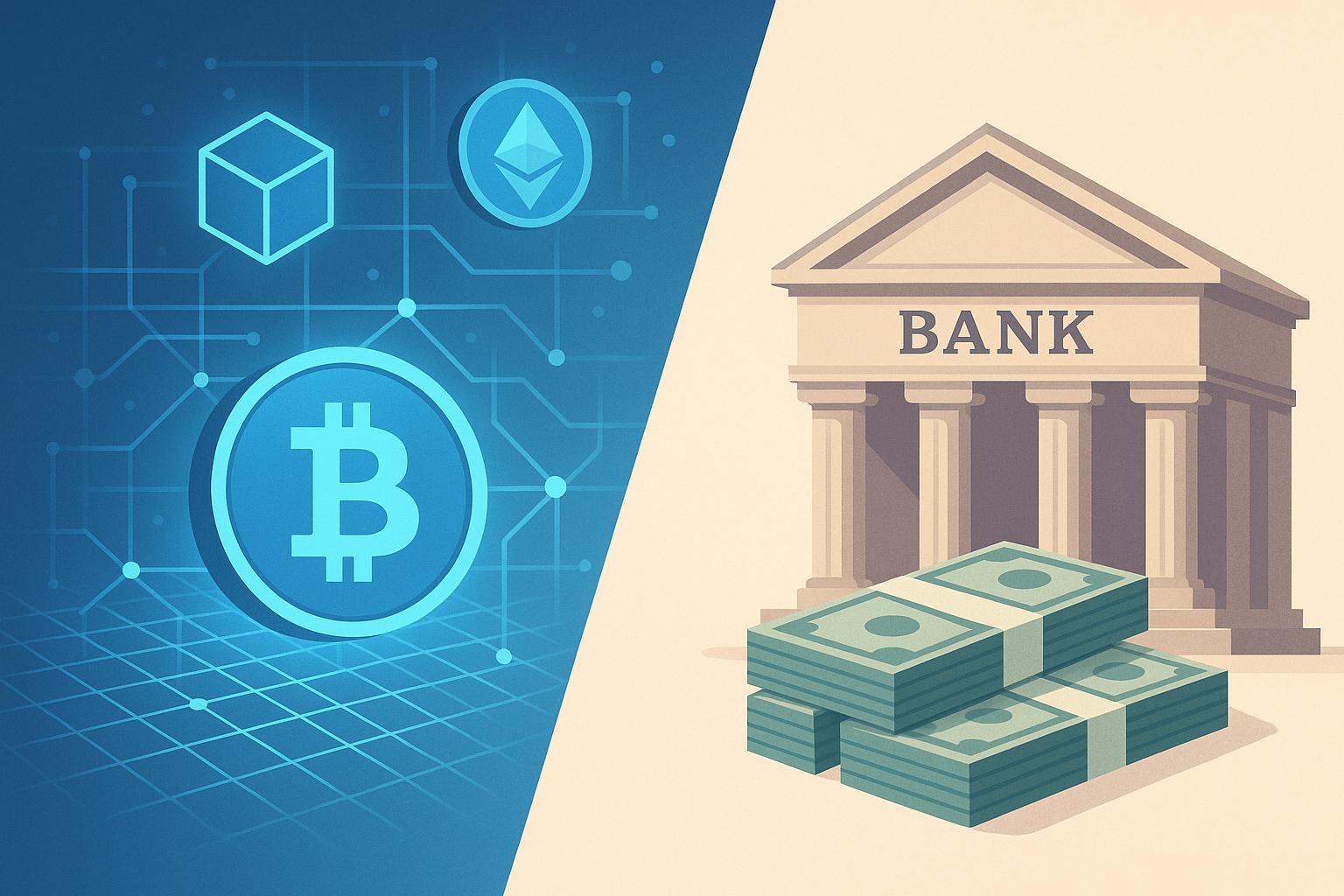
For years, cryptocurrency and traditional banking occupied seemingly opposite sides of the financial conversation. One represented an emerging financial system built around decentralisation, digital assets and blockchain technology. The other was an established structure supported by commercial banks, central banks and decades of financial regulation.
The debate was often framed as a question of replacement. Could cryptocurrency eventually challenge traditional banks? Would blockchain make some existing financial systems unnecessary? And how much of the financial world would have to change before digital assets became part of everyday transactions?
Interestingly, the industry is beginning to offer a different answer.
Rather than abandoning traditional banking, some of the world's biggest financial institutions are exploring how to bring blockchain technology into their existing operations. Banks that once approached cryptocurrency cautiously are now experimenting with digital deposits, tokenised assets and blockchain-powered payment infrastructure.
One recent development illustrates just how quickly this relationship is evolving.
On November 2, 2026, Standard Chartered announced the launch of its Tokenised Deposits solution in Hong Kong. The service allows corporate clients, banks, investment platforms and digital asset businesses to use commercial bank deposits within blockchain-based treasury and investment operations.
The solution uses the Hong Kong Monetary Authority's EnsembleTX infrastructure to facilitate transfers between participating institutions, with settlement in central bank money, including wholesale central bank digital currency. Standard Chartered also confirmed that China AMC, Finloop and PantherTrade had executed live transactions through the system.
This is more than another bank experimenting with blockchain. It demonstrates how technology associated with cryptocurrency is finding a place inside established financial infrastructure.
And it raises an interesting question: what happens when the technology behind crypto starts powering the traditional banking system?
The Technology Banks Once Watched From a Distance
To understand this development, it helps to look at what blockchain actually offers.
Blockchain is a digital record-keeping system that allows transactions and information to be recorded and verified across a network. Rather than depending entirely on one central database, participating institutions can share a synchronised record of transactions.
In cryptocurrency, this technology makes it possible to transfer digital assets without relying on a conventional bank to process every transaction.
Traditional banking, however, has historically depended on multiple systems, intermediaries and settlement processes to move money between institutions, particularly across borders. This can make international transactions expensive, time-consuming and operationally complicated.
Blockchain offers another possibility: a shared digital infrastructure where transactions can be recorded, verified and settled more efficiently.
For banks, the attraction is not necessarily decentralisation or replacing existing currencies. It is the opportunity to make the financial systems they already operate faster, more connected and potentially available around the clock.
That is why tokenisation is becoming an increasingly important part of the conversation.
What Exactly Are Tokenised Deposits?
The term might sound like another complicated cryptocurrency concept, but the idea is relatively straightforward.
A tokenised deposit is money held in a traditional commercial bank account but represented digitally on a blockchain or another distributed ledger.
Think of it this way: instead of transferring money exclusively through conventional banking infrastructure, an eligible customer can move a digital representation of their bank deposit through a blockchain-based system.
The important distinction is that the money remains a bank deposit.
It is not Bitcoin. It is not a stablecoin issued by an independent cryptocurrency company. It represents a claim on the bank that issued the deposit and remains within the regulated banking system.
This matters because tokenised deposits combine aspects of traditional banking with the programmability and transfer capabilities of blockchain technology.
Research published by the Federal Reserve Bank of Dallas in July 2026 also examined how tokenised deposits could improve payment efficiency for retail and institutional customers. It distinguished them from stablecoins, which are generally backed by reserves of assets held by their issuers rather than representing direct deposits on a commercial bank's balance sheet.
In simple terms, banks are exploring ways to make existing money move using a new technological infrastructure without necessarily changing what that money represents.
Stablecoins, Bitcoin and Tokenised Deposits Are Not the Same Thing
With all three increasingly appearing in conversations about digital finance, it is easy to assume they serve the same purpose. They do not.
Bitcoin is a decentralised cryptocurrency whose price is determined by market demand and supply. It is not issued by a commercial bank and does not represent a deposit held in a traditional banking institution.
Stablecoins, on the other hand, are digital assets designed to maintain a relatively stable value, often by being pegged to currencies such as the US dollar. USDT and USDC are familiar examples.
Tokenised deposits are different. They represent money deposited with a commercial bank, with blockchain providing another way to transfer and manage that money.
The differences become clearer when we consider who issues them and what they represent.
Bitcoin operates without a central issuing institution. Stablecoins are issued by private entities that manage reserves intended to support their value. Tokenised deposits, meanwhile, are issued by commercial banks and represent claims on those institutions.
Their purposes also differ. Bitcoin functions as a decentralised digital asset and payment network, while stablecoins facilitate digital payments and value transfers. Tokenised deposits are primarily designed to modernise banking and institutional money movement.
This matters because blockchain adoption does not automatically mean banks are adopting cryptocurrency itself. They are increasingly adopting the technology while retaining their existing financial structures.
Why Banks Are Interested in This New Direction
One of the biggest attractions is the possibility of moving money beyond conventional banking hours.
Traditional financial systems often operate within established processing and settlement windows. International transactions can involve several institutions, different time zones and multiple stages of verification.
For businesses managing large amounts of money across different markets, these delays can affect liquidity and operational planning.
Tokenised deposits offer an alternative by allowing participating institutions to transfer digital representations of bank deposits through shared infrastructure, potentially enabling faster settlement and more efficient treasury management.
There is also the question of programmability.
Blockchain-based financial transactions can be designed to follow predefined conditions. For example, a payment could be programmed to execute once certain requirements are satisfied, reducing the need for repeated manual processes.
These capabilities could prove useful for corporate payments, investment transactions, cross-border transfers and the management of funds across different business operations.
Standard Chartered's Hong Kong launch is a practical example of this direction. The bank is also working with Fireblocks to connect its banking capabilities with digital asset businesses, bringing traditional financial services closer to the wider digital asset ecosystem.
The development is not happening in isolation either.
In August 2026, Standard Chartered and HSBC announced the completion of a live cross-border tokenised deposit transaction using Swift's blockchain-based ledger. The transaction demonstrated how regulated bank deposits could be transferred between institutions through blockchain infrastructure.
Meanwhile, a separate initiative announced by major US financial institutions in June 2026 is exploring how tokenised commercial bank money can connect with established payment networks, including systems operated by The Clearing House.
The message is becoming increasingly clear: traditional financial institutions are not waiting for blockchain to disappear. They are exploring how to make it work within their systems.
Will Customers Notice the Difference?
Perhaps the most interesting part of this development is that customers may not immediately recognise when blockchain becomes part of their banking experience.
Imagine a business transferring funds between two participating financial institutions. Today, that process may involve different banking systems and settlement arrangements. With tokenised deposits, the transfer could take place through shared digital infrastructure, potentially making the process faster and more efficient.
The business may simply notice that its money moves more quickly, transactions are easier to reconcile and treasury operations become less complicated.
However, this does not mean every bank transfer will suddenly become instantaneous.
The benefits depend on participating institutions, regulatory approval, interoperability between systems and the underlying settlement arrangements. The technology also introduces considerations around cybersecurity, liquidity, operational resilience and governance.
For now, Standard Chartered's new solution is designed primarily for corporate and institutional clients, not as a general replacement for everyday retail bank accounts.
Still, the direction of travel is worth watching. Infrastructure developed for institutional finance today could influence the payment experiences available to ordinary customers in the future.
What Does This Mean for Africa?
Traditional banks are adopting blockchain through tokenised deposits and digital payment infrastructure. Discover what this means for banking, stablecoins and the future of African Traditional banks are adopting blockchain through tokenised deposits and digital payment infrastructure. Discover what this means for banking, stablecoins and the future of African finance.
For Africa, the convergence between traditional finance and blockchain technology presents an interesting opportunity.
Cross-border payments remain an important challenge for businesses, individuals and financial institutions operating across different African markets. Differences in currencies, banking infrastructure, processing times and transaction costs can make moving money between countries complicated.
Blockchain-based financial infrastructure could offer new ways to improve how institutions coordinate payments, manage liquidity and settle transactions.
The potential is particularly relevant to businesses involved in international trade, remittances and digital commerce.
However, adopting these systems will require more than technological enthusiasm. African financial institutions will need appropriate regulatory frameworks, reliable digital infrastructure, cybersecurity protections and cooperation between regulators and payment providers.
There is also an opportunity for fintech companies.
As banks explore tokenised deposits and blockchain-based settlement, fintech platforms could become important bridges between conventional financial services and emerging digital payment infrastructure.
But the transition will not happen overnight, and the experience of Hong Kong or other developed financial markets cannot simply be replicated across Africa without considering local banking structures and regulatory conditions.
For African markets, the real opportunity lies in adapting these developments to solve existing financial problems rather than adopting blockchain simply because it is becoming popular.
The Future May Not Be Banks Versus Crypto
For a long time, the conversation surrounding cryptocurrency centred on whether digital assets would replace traditional financial institutions.
But the emerging picture suggests that the future could be more complicated, and perhaps more interesting.
Banks are exploring blockchain. Payment networks are considering on-chain settlement. Stablecoins are becoming increasingly relevant to digital payments, while tokenised deposits are bringing commercial bank money onto digital ledgers.
These developments do not mean traditional banking and cryptocurrency have become identical, nor does blockchain adoption guarantee that every financial institution will eventually use the technology.
What they demonstrate is that the financial industry is becoming more interconnected.
The next major shift in money may not come from one system defeating another. It could come from different financial technologies learning to work together.
And when that happens, the biggest change may not be what money looks like, but how easily, quickly and securely it moves.
The future of finance may not belong exclusively to traditional banks or crypto. It may belong to whoever understands how to bring the best of both worlds together.
Moving With the Changing Financial Landscape
As the financial world evolves, the ability to move between digital assets and everyday spending remains important. Whether you're converting supported cryptocurrencies into naira, paying your electricity bill, renewing your cable subscription, funding your betting wallet or buying airtime and data, Monica brings these everyday financial activities together in one app.
Blockchain may be changing how the financial world moves money, but managing your everyday financial needs should not have to feel complicated.
Explore a smarter way to move from crypto to naira and take care of everyday payments. Let Monica handle the conversion while you get on with what matters.
Download Monica today: https://monica.cash/app and let your money move with you.