
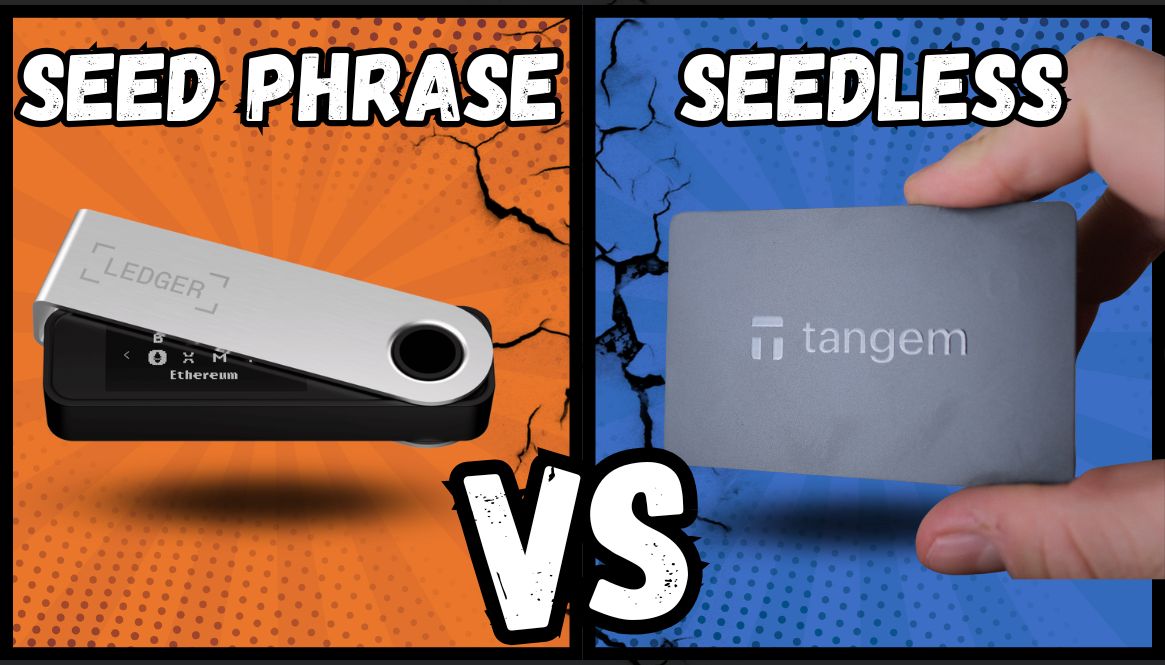
The 12 Words That Can Make or Break Your Crypto Experience
Imagine losing your phone tomorrow. You get another one, download your cryptocurrency wallet and attempt to regain access to your funds. Then comes the question: Do you have your recovery phrase?
For many crypto users, this is where the real test begins.
That familiar sequence of 12 or 24 words is more than a backup note. It is a recovery mechanism that can restore access to a wallet and the digital assets associated with it. In many traditional self-custody wallets, the phrase represents the underlying secret from which the wallet's private keys are derived.
Anyone who obtains a valid recovery phrase may be able to access the assets it controls. This is why users are repeatedly warned against sharing it, storing it carelessly or entering it on unfamiliar websites.
For years, this arrangement has been central to cryptocurrency self-custody. You control your wallet, you protect your recovery phrase and you are responsible for ensuring that nobody else gets their hands on it.
It offers independence, but that independence comes with a considerable responsibility.
A misplaced piece of paper, a damaged backup or a recovery phrase exposed through a phishing attack could result in permanent loss of access.
Now, the industry is exploring a different approach.
What if recovering a wallet did not depend on keeping a list of secret words safe?
That is the idea behind seedless wallets, and it is changing the conversation around how people access and protect their digital assets.
Understanding the Traditional Seed Phrase Wallet
Before comparing the two approaches, it is worth understanding why seed phrases became so important.
A traditional self-custody wallet gives users control over their private keys rather than leaving those keys entirely in the hands of a centralised exchange or service provider.
During setup, the wallet generates a recovery phrase, commonly consisting of 12 or 24 words. These words can be used to restore the wallet on another compatible device if the original phone or computer is lost, damaged or replaced.
The biggest advantage is independence.
You do not necessarily need permission from a company to recover your wallet. As long as you have the correct recovery phrase and use compatible wallet software, you can restore access yourself.
For experienced cryptocurrency users, this is an important part of financial control.
However, the responsibility is entirely yours.
Saving the phrase in an unsecured phone note, taking a screenshot, sending it through WhatsApp or entering it into a suspicious website can expose your wallet to attackers. Even physical backups require careful handling because paper can be damaged, misplaced or destroyed.
The system is not necessarily insecure. In fact, a properly generated recovery phrase stored securely offline can provide a strong recovery mechanism.
The challenge is that users must understand how to protect it.
And not everyone entering the crypto space is prepared for that responsibility.
Enter Seedless Wallets: A Different Approach to Access
Seedless wallets are designed to reduce or eliminate the need for users to manage a conventional recovery phrase.
Instead of relying on one set of words as the primary recovery mechanism, these wallets may use technologies such as multi-party computation, passkeys, smart contract-based recovery or trusted recovery contacts.
The goal is to make wallet access more convenient while reducing certain risks associated with traditional seed phrase management.
But seedless is an umbrella term, not one specific technology. Different wallets achieve it in different ways.
One approach is Multi-Party Computation (MPC).
MPC distributes the signing authority across multiple key shares rather than keeping one complete private key in a single location. These shares participate in authorising transactions without necessarily reconstructing the entire private key in one place.
Depending on the wallet's design, the shares may be distributed between a user's device, a service provider and other authorised systems.
Another approach involves passkeys.
Passkeys allow users to authenticate using supported device security features, such as biometrics or a device PIN. They are designed to replace traditional passwords and can make signing in more convenient.
However, a passkey is an authentication method, not automatically a complete wallet recovery system. Whether it removes the need for a seed phrase depends on how the wallet is designed.
There is also social recovery.
With this arrangement, users designate trusted individuals or accounts, often called guardians, who can help restore access under specific conditions. Instead of relying entirely on one recovery phrase, the wallet uses an established recovery process involving these trusted parties.
Each approach has its own technical requirements, advantages and limitations.
What they share is an attempt to make cryptocurrency access less intimidating and reduce the possibility of losing everything because a recovery phrase was misplaced or exposed.
Convenience Versus Control: Where Do They Differ?
This is where the comparison becomes particularly interesting.
Traditional seed phrase wallets offer a straightforward form of independent recovery. Users who understand self-custody can restore their wallets without necessarily depending on a particular company or service provider.
Seedless wallets, on the other hand, can make the experience easier, particularly for beginners who may find managing recovery phrases confusing.
But convenience does not automatically translate into better security.
Consider what happens when something goes wrong.
With a traditional wallet, losing your device may not be a major problem if your recovery phrase is safely stored. However, if the phrase is lost or compromised, the consequences can be severe.
With a seedless wallet, recovery may be possible through a passkey, another device, a guardian or a distributed signing arrangement. Yet the process may depend on the security of those systems.
If your recovery depends on an email account, what happens if someone compromises that account? If a service provider participates in the signing process, what happens if its infrastructure becomes unavailable? If your guardians cannot be reached, can you still recover access?
These are important questions because removing one security risk can introduce another.
A traditional recovery phrase can be vulnerable to theft, accidental disclosure and physical damage. Seedless arrangements can face risks involving compromised devices, account recovery, malicious applications, service providers and poorly designed key-management systems.
Neither approach is automatically safer simply because of how it is named.
What Should You Consider Before Choosing a Wallet?
Choosing a cryptocurrency wallet requires more than looking at how quickly you can create an account or how convenient the login process appears.
There are several things worth understanding before entrusting any wallet with your digital assets.
1. Know who controls the private keys
A wallet described as seedless is not automatically non-custodial. Understand whether you retain control over transaction authorisation or whether a company has significant control over your assets.
2. Understand how recovery works
Do not wait until your phone is lost to discover how to recover your wallet. Find out whether you can restore access independently, whether another device is required and whether a third party must participate.
3. Examine security practices
Look for independent security audits, transparent technical documentation and a clear explanation of how private keys, key shares and authentication systems are protected.
4. Consider supported networks
Not every wallet supports every blockchain. If you use Bitcoin, Ethereum or Solana, check that the wallet supports the networks and assets you need.
5. Do not confuse convenience with complete protection
Biometric authentication and passkeys can simplify access, but they do not eliminate phishing, malicious applications, compromised devices or fraudulent transactions. Your overall security habits still matter.
Ultimately, the right wallet is one whose security arrangements you understand and whose recovery process you can trust.
Is the Seed Phrase Becoming Obsolete?
Not quite.
The emergence of seedless wallets does not mean traditional recovery phrases are suddenly outdated or unsafe. They remain an important part of cryptocurrency self-custody, particularly for users who value independent control and understand how to protect their backups.
However, the industry is beginning to recognise that expecting every cryptocurrency user to become an expert in managing cryptographic secrets is not necessarily the best way to encourage adoption.
For someone entering crypto for the first time, the idea that a list of words could determine whether they ever regain access to their assets can be intimidating.
Seedless technologies are attempting to make that experience less complicated.
The bigger development is the growing effort to balance three important aspects of wallet security: control, convenience and recoverability.
A wallet may offer excellent protection against unauthorised access, but if its recovery system leaves legitimate users permanently locked out, that presents another problem. Equally, a wallet that makes access effortless but gives excessive control to an external provider raises legitimate security concerns.
The future may not belong exclusively to seed phrase wallets or seedless alternatives. Both approaches have their place, and their effectiveness depends on how well they are designed and implemented.
For now, those 12 words are not going anywhere. But they are no longer the only approach being explored.
Perhaps the real evolution in cryptocurrency security is not about getting rid of the recovery phrase altogether. It is about finding better ways to protect digital assets without making security unnecessarily difficult for the people using them.
Your Crypto Has Somewhere to Go
Whether you prefer traditional self-custody or newer wallet technologies, understanding how your digital assets are protected is only one part of managing your crypto.
The other part is knowing how to put those assets to practical use.
When it is time to convert your supported cryptocurrency into naira, Monica makes the process straightforward. From Bitcoin, Ethereum, USDT, USDC and Solana conversions to everyday financial needs such as airtime, data, electricity bills, cable subscriptions and betting wallet funding, Monica brings crypto conversion and useful payment services into one convenient app.
Your crypto journey should not end with holding digital assets. It should also give you practical ways to use their value in everyday life.
Ready to make your crypto work beyond the blockchain? Download Monica, convert your supported crypto to naira and take care of everyday payments in one place.
Download Monica: https://monica.cash/app