Skip to content

How to receive crypto payments in Nigeria

Your client sends crypto to your Monica address from anywhere in the world. It lands as naira within 60 seconds of the network confirming.

Get your wallet address
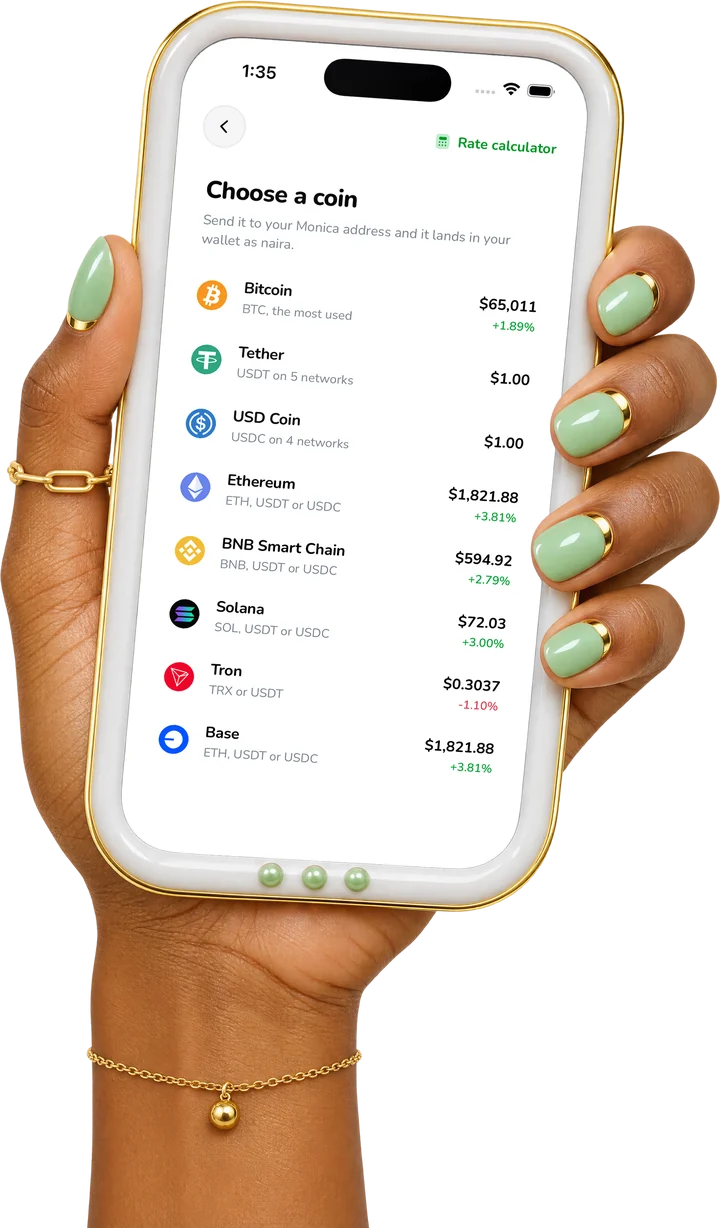
A hand with mint green nails and a gold chain ring holding a phone in a white and gold case, open on the Monica screen where you choose the coin to send

Invoice in dollars. Get paid in crypto. Cash out in naira.

Quick answer: To receive crypto payments in Nigeria, set up a Monica account to get permanent deposit addresses for Bitcoin, USDT, ETH and 4 other cryptocurrencies. Share your address with payers by invoice or message. When crypto arrives, Monica automatically converts it to naira within 60 seconds of the network confirming. Withdraw to any Nigerian bank for free. Ideal for freelancers, small businesses and content creators.

Invoice 2026/0015

$5,000.00

TechCorp LLC, San Francisco

Paid

  1. Invoice sent

    22 February 2026

    In dollars, with your Monica address on it.

  2. Client pays

    By 7 March 2026

    5,000 USDT on Tron (TRC20).

  3. Network confirms

    Usually 1 to 3 minutes

    Nothing for you to do.

  4. Naira in your Monica balance

    Within 60 seconds

    At the live rate, with a 0% conversion fee.

  5. Naira in your bank

    When you withdraw

    Any Nigerian bank on NIBSS, with a 0% bank withdrawal fee.

One invoice from sent to paid. See the full invoice
In this article
  1. Why receive payments in crypto in Nigeria?
  2. Setting up crypto payment receiving with Monica
  3. Which crypto should you accept?
  4. Best practices for invoicing in crypto
  5. Receiving crypto payments as different professionals
  6. Network considerations: getting the best deal
  7. Converting received crypto to naira on Monica
  8. Tax implications of receiving crypto payments in Nigeria
  9. Security best practices for receiving crypto payments
  10. Frequently asked questions

Why receive payments in crypto in Nigeria?

Crypto payments get around the limits of traditional international payment methods in Nigeria. No gateway restrictions, no expensive wire transfer fees, no remittance agent markups. Receive payment from anywhere in the world and convert it to naira within 60 seconds of the network confirming, at competitive rates.

For millions of Nigerians working in the global digital economy, receiving payments has always been a pain point. Traditional methods come with severe limits: wire transfers cost $25 to $45 and take 3 to 7 days, and domiciliary account conversions come with unfavourable bank exchange rates.

Getting paid from abroad.

Wire transfer

Fees
$25 to $45
Time
3 to 7 days

Crypto payment

Network fee
$1 to $3
regardless of the amount
Time
Minutes

Crypto payments solve these problems. A client in New York, London, Dubai or Singapore can send you Bitcoin or USDT in minutes, at a cost of $1 to $3, regardless of the amount. There are no intermediary banks taking their cut, no currency conversion markups from several institutions, and no arbitrary limits from intermediary banks on how much you can receive.

Receiving crypto payments with automatic naira conversion on Monica gives Nigerian workers, entrepreneurs and creators a quick, low cost and reliable payment pipeline in 2026.

Setting up crypto payment receiving with Monica

Monica gives you unique wallet addresses for 7 cryptocurrencies. Share the right address with your payer, and Monica handles the rest: automatic conversion to naira, free bank withdrawal and a full transaction history for your records.

Do this once.

  1. Step 1: Download and create your Monica account

    Download the Monica app from the App Store or Google Play, or visit monica.cash/app. Registration takes about 3 minutes. You will need to verify your identity (NIN and a selfie) to enable naira withdrawals, which is standard for all platforms in Nigeria.

  2. Step 2: Get your wallet addresses

    Once your account is set up, open the wallet section. You will see a deposit address for each supported cryptocurrency: Bitcoin (BTC), USDT (Tether), Ethereum (ETH), USDC, Solana (SOL), Tron (TRX) and BNB. Each address is unique to your account. Copy the address for the cryptocurrency your payer will send.

    Important: For USDT, note which network is being used. Monica supports USDT on several networks (TRC20, ERC20 and others). Make sure your payer sends on the network that matches your address.

Every time a client pays.

  1. Step 3: Share your address with the payer

    Send your wallet address to your client, employer or whoever is making the payment. You can share it by email or in a messaging app, or put it on your invoice. Always copy the address directly from the Monica app. Never type it by hand: a single wrong character means lost funds.

  2. Step 4: Receive and convert automatically

    When the payer sends crypto to your Monica address, Monica converts it to naira automatically once the blockchain confirms it. You do not need to do anything. The naira amount appears in your balance at the market rate at the time of confirmation, within 60 seconds of the network confirming. How long the network takes depends on the cryptocurrency and on congestion.

  3. Step 5: Withdraw naira to your bank

    Withdraw your naira balance to any Nigerian bank account with a 0% conversion fee and a 0% bank withdrawal fee. Add your bank details once, and future withdrawals are instant. Monica pays into every Nigerian bank on NIBSS, including GTBank, Access Bank, First Bank, UBA, Zenith, Kuda, OPay and PalmPay.

Which crypto should you accept?

USDT (Tether) is the recommended cryptocurrency for receiving payments because it holds a stable $1 value, so the amount you invoice is exactly the amount you receive. Bitcoin is excellent for larger payments, where the flat $2 Bitcoin deposit fee is negligible. Ethereum and Solana are good alternatives, depending on what the sender prefers.

Seven cryptocurrencies compared for receiving payments: what each is best for, the Monica deposit fee, the network confirmation time and how much the price moves
CryptoGood forMonica deposit feeNetwork confirmation timeVolatility
Holds a stable $1.
USDT (Tether)All payment sizes, invoicingFree depositConfirms in 1 to 10 minutesVolatility: None (stable at $1)
USDCClients in the US, complianceFree depositConfirms in 2 to 15 minutesVolatility: None (stable at $1)
Moves with the market.
Bitcoin (BTC)Large payments ($500+)$2 flat depositConfirms in 15 to 40 minutesVolatility: High
Ethereum (ETH)Tech savvy clientsFree depositConfirms in 2 to 15 minutesVolatility: High
Solana (SOL)Web3 companies, low feesFree depositConfirms in 1 to 5 minutesVolatility: High
Tron (TRX)Asian clients, low feesFree depositConfirms in 1 to 3 minutesVolatility: Medium
BNBBinance usersFree depositConfirms in 2 to 5 minutesVolatility: High

Best practices for invoicing in crypto

Professional crypto invoicing needs clear details: the cryptocurrency, the network, your wallet address, the USD amount and the payment deadline. Include conversion instructions if your client is new to crypto. A well structured crypto invoice builds client confidence and makes payment smooth.

What to include on a crypto invoice

Your crypto invoice should contain everything a traditional invoice has, plus specific crypto details:

  • Your name or business name and contact details
  • Client name and details
  • Invoice number and date
  • Description of the services or products provided
  • Amount in USD (always invoice in USD for clarity, even though payment will be in crypto)
  • Cryptocurrency accepted (say “USDT preferred” or “Bitcoin accepted”)
  • Network (say “Tron TRC20” for USDT, or “Bitcoin mainnet” for BTC)
  • Your wallet address (copy and paste it, never type it by hand)
  • Payment deadline
  • A note about confirming payment (ask your client to share the transaction hash, or TXID, after sending)

Invoice

2026/0015

From
Adebayo Johnson
[email protected]
To
TechCorp LLC
San Francisco, CA
Date
22 February 2026
Due
7 March 2026
Services and amounts
ServiceAmount
Frontend development (40 hours)$3,200.00
API integration (15 hours)$1,200.00
Code review and documentation$600.00
Total$5,000.00 USD
Payment method
USDT (Tether) on the Tron network (TRC20)
Wallet address
TXyz...abc123 (copy from the Monica app)
Note
Please send exactly $5,000 USDT to the address above using the Tron (TRC20) network. After sending, please share the transaction hash for my records. Thank you!

Sender fee $0.50 to $1. Confirms in 1 to 3 minutes.

A sample crypto invoice. Choose another coin to see its payment lines.

Receiving crypto payments as different professionals

One Monica address for each coin works for every client. What changes is where you share it.

Freelancers (developers, designers, writers)

On your invoice.

As a Nigerian freelancer receiving crypto, set up your Monica deposit address once and reuse it for all clients. Invoice in USD and request USDT for predictable amounts. Most clients on Upwork, Fiverr or direct contracts can send crypto from Coinbase, Binance or any wallet. You can save 3 to 8% compared with traditional payment channels.

Small businesses and online stores

At checkout, next to bank transfer.

If you run an online business selling products or services, adding a crypto payment option opens you to global customers. Display your Monica USDT address as a payment method alongside bank transfers. For online stores, consider USDT for its price stability, since the amount at checkout is the amount you receive.

Building crypto to naira into your own product? See the off ramp API.

Content creators and influencers

In your link in bio or media kit.

YouTubers, podcasters and social media creators can receive sponsorship payments, tips and affiliate commissions in crypto. Add your Monica wallet address to your link in bio, media kit or donation page. Crypto tips from international fans convert to naira within 60 seconds of the network confirming, with no payment gateway limits.

Remote workers and consultants

In your salary details.

If you work remotely for an international company, propose crypto salary payments. Many forward thinking companies are willing to pay in USDT or BTC, especially in tech and Web3. You receive more because there are no bank intermediary fees, and conversion to naira happens within 60 seconds of the network confirming on Monica.

Network considerations: getting the best deal

The blockchain network your payer uses directly affects speed and cost. For USDT, the Tron (TRC20) network is low cost and quick. For Bitcoin there is only one network, but fees vary with congestion. Always tell your payer the correct network to avoid lost funds.

One of the most common mistakes when receiving crypto payments is a network mismatch. USDT, for example, exists on several blockchains: Ethereum (ERC20), Tron (TRC20), Binance Smart Chain (BEP20), Solana and others. If your Monica address is for USDT on Tron (TRC20) but your client sends USDT on Ethereum (ERC20), the funds could be delayed or potentially lost.

Network comparison for USDT payments

Four networks for USDT payments compared on sender fee, confirmation time and best use
NetworkSender feeConfirmation timeGood for
Tron (TRC20)Sender fee $0.50 to $1Confirms in 1 to 3 minutesMost payments (recommended)
Ethereum (ERC20)Sender fee $3 to $20 or moreConfirms in 2 to 15 minutesLarge payments where the fee is negligible
BSC (BEP20)Sender fee $0.10 to $0.50Confirms in 1 to 5 minutesBinance users
Solana (SPL)Sender fee $0.01 to $0.05Confirms in under 1 minuteLowest possible fees
Same network on both sides.
Your Monica address
USDT on Tron (TRC20)
Your client sends on
Tron (TRC20)Arrives
Your client sends on
Ethereum (ERC20)Delayed or potentially lost

Critical warning: Always confirm the network with your payer before they send funds. Sending crypto on the wrong network can result in permanent loss of funds. If your client is unsure, walk them through the process or ask them to send a small test amount first ($5 to $10).

Converting received crypto to naira on Monica

The beauty of Monica for receiving crypto payments is that conversion happens automatically. There is no separate step to “sell” or “convert” your crypto. When cryptocurrency arrives at your Monica wallet address and receives enough blockchain confirmations, Monica converts it to naira at the current market rate and credits your naira balance.

This automatic conversion removes the risk of price swings on payments in coins that are not stablecoins. If a client sends you Ethereum, for example, Monica converts it to naira within 60 seconds of confirmation, locking in the rate at that moment rather than leaving you exposed to ETH price moves while you try to sell by hand.

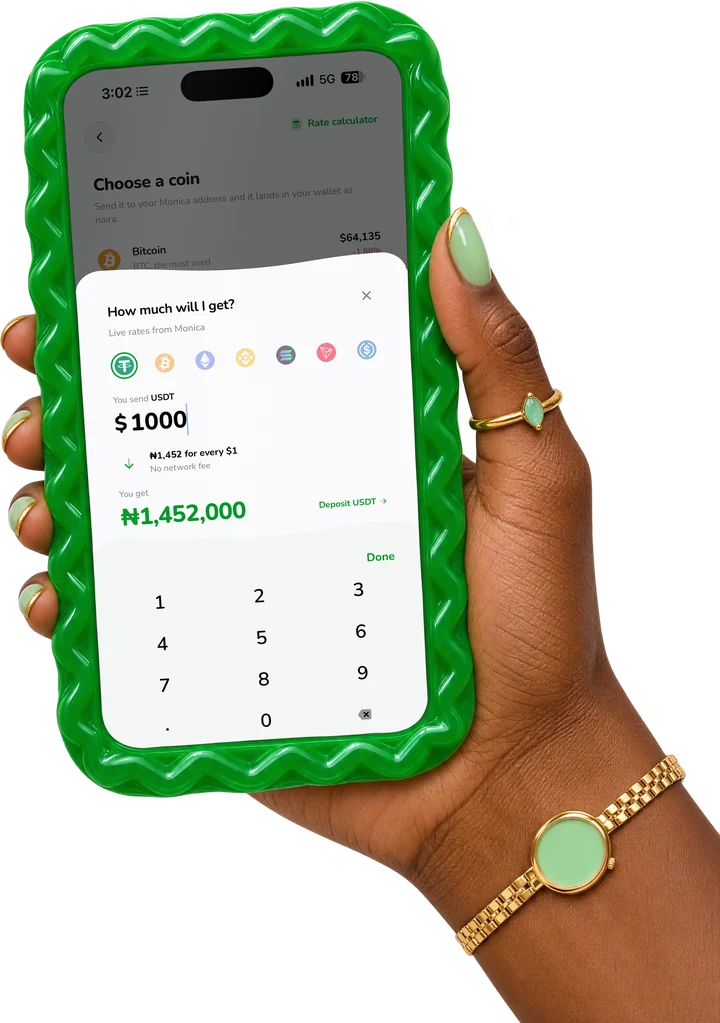
Use the Monica crypto calculator to check current conversion rates before quoting prices to clients. This helps you make sure the naira amount you receive meets your expectations after conversion.

The rate calculator in the Monica app. The rate on this screen is an example; the app shows the live rate.

A hand with jade green nails and a gold watch holding a phone in a green case, open on the Monica rate calculator, which shows how much naira a USDT amount comes to

Tax implications of receiving crypto payments in Nigeria

Income received in cryptocurrency is taxable in Nigeria, just like income received in naira or any other currency. Keep records of all crypto payments you receive for tax reporting. Monica's transaction history gives you a full record of all conversions and withdrawals.

The Nigerian tax system treats cryptocurrency income the same as any other form of income. Whether you are a freelancer, business owner or content creator, payments received in crypto are subject to income tax at applicable rates. Key considerations include:

  • Record keeping: Keep records of every crypto payment you receive, including the USD and naira equivalent at the time of receipt, the payer details and the nature of the transaction. Monica's transaction history provides dates, amounts and conversion rates for all deposits.
  • Invoicing: Always issue invoices in USD and keep copies. This establishes the income amount independent of crypto price movements.
  • VAT considerations: If your business is registered for VAT, the supply of goods or services remains subject to VAT regardless of whether payment is received in naira, USD or cryptocurrency.
  • Professional advice: Given the evolving nature of crypto taxation in Nigeria, consult a tax professional who understands both Nigerian tax law and cryptocurrency transactions. The SEC regulatory framework provides some guidance, but tax specifics require professional counsel.

Security best practices for receiving crypto payments

Protecting your wallet address

  • Always copy your address directly from the Monica app. Never type it by hand.
  • After pasting, check that the first and last 4 to 6 characters match your actual address.
  • Turn on every security feature available in your Monica account (PIN, biometric, 2FA).
  • Use a dedicated email address for your Monica account that you do not use anywhere else.

Verifying payments

  • Ask clients to share the transaction hash (TXID) after sending payment, so you can check the transaction yourself on a blockchain explorer.
  • Do not release deliverables until Monica confirms the crypto has been received and converted. “Pending” transactions are not confirmed transactions.
  • For large payments, ask for a small test transaction first to check that the address and network are correct.

Frequently asked questions

Still unsure? Chat with us.
How do I receive crypto payments in Nigeria?

Set up a Monica account to get permanent deposit addresses for Bitcoin, USDT, ETH and the other supported coins. Share your deposit address with payers. When they send crypto, Monica automatically converts it to Naira within 60 seconds of the network confirming. Withdraw to any Nigerian bank for free.

Which cryptocurrency should I accept for payments in Nigeria?

USDT (Tether) is recommended for most payment scenarios because it maintains a stable $1 value, eliminating price volatility between sending and receiving. Bitcoin is ideal for larger payments. Both convert to Naira on Monica within 60 seconds of the network confirming, with a 0% conversion fee; USDT deposits are free and Bitcoin deposits carry a flat $2 fee.

Is receiving crypto payments legal in Nigeria?

Yes, receiving cryptocurrency payments is legal in Nigeria. The SEC has established a regulatory framework for virtual asset service providers. Monica is a crypto off ramp, not an exchange and not a bank. While the CBN restricted banks from directly facilitating crypto between 2021 and December 2023, individual ownership, receipt, and conversion of crypto remained legal, and that restriction has since been lifted.

Do I need to pay taxes on crypto payments in Nigeria?

Yes, income received in cryptocurrency is taxable like any other income in Nigeria. Freelance income, business revenue, and service payments received in crypto should be reported. Keep records of all transactions using Monica's transaction history feature. Consult a Nigerian tax professional for specific guidance.

What network should I use to receive crypto payments?

For USDT, the Tron (TRC20) network offers the lowest fees (under $1) and quick confirmation times. For Bitcoin, there is only one network. For ETH, use the Ethereum mainnet. Always ensure the sender uses the same network as your receiving address to avoid lost funds.

A rubber stamp with a deep green handle and a brass collar

Start receiving crypto payments today.

Set up your Monica wallet in 3 minutes and get your crypto deposit addresses instantly.

Get your wallet address

4.5 on Google Play from 13,000+ reviews. 700,000+ users.

Get the app

Scan with your phone camera.

Point your camera at the code and tap the link that pops up. It takes you to the right store for your phone.

Free on iOS and Android.

monica.cash/app