TradFi Meets DeFi as the Lines Between Banking and Crypto Blur
Traditional financial institutions are adopting blockchain technology while crypto platforms explore more conventional financial services. The convergence could reshape payments, trading and access to financial markets, but important differences remain.
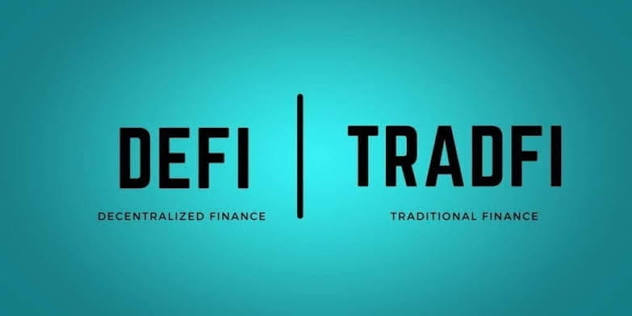
For years, traditional finance and decentralised finance seemed to occupy opposite ends of the financial world. One operated through banks, brokers and regulated institutions. The other promised a different model, using blockchain technology and smart contracts to let people transact without relying on conventional intermediaries.
That boundary is no longer clearly defined.
Banks are exploring blockchain-based payments and tokenised deposits. Financial market operators are developing systems for tokenised securities, while crypto companies continue building products that connect digital assets with conventional financial services.
The result is a growing convergence between traditional finance, commonly called TradFi, and decentralised finance, or DeFi. Rather than one replacing the other, elements of both are increasingly finding their way into the same financial ecosystem.
And the implications could extend far beyond cryptocurrency trading.
When Wall Street starts speaking blockchain
One of the clearest signs of this shift is the growing interest in tokenisation.
Tokenisation involves representing ownership of an asset, such as a share, bond or fund, as a digital token on a blockchain. Depending on how the system is designed, this can make it easier to transfer assets, automate certain processes and coordinate transactions across financial institutions.
The attraction is straightforward: traditional financial markets often rely on multiple intermediaries to process, verify and settle transactions. Blockchain-based infrastructure could streamline some of these processes and make certain transactions possible around the clock.
The Depository Trust & Clearing Corporation, a major US financial market infrastructure provider, has been developing a service for tokenised securities, with a planned launch in October 2026. Its initiative has involved more than 50 financial industry firms, reflecting growing institutional interest in digital asset infrastructure.
Meanwhile, a September 2026 UK banking initiative demonstrated how tokenised deposits could be used in transactions between major banks. The participating institutions tested transfers involving mortgage transactions and a simulated online purchase, exploring how programmable payments might improve the movement of money.
These developments are important because they show that blockchain adoption is no longer confined to crypto-native businesses. Traditional institutions are investigating how the technology could improve the financial systems they already operate.
DeFi is changing, but it is not the same as TradFi
Decentralised finance emerged around a different proposition: financial services could operate through blockchain networks and smart contracts, with users interacting directly with protocols rather than depending entirely on banks or other centralised intermediaries.
DeFi platforms support activities such as lending, borrowing, trading and providing liquidity. Transactions can be executed automatically when specified conditions are met, although users remain exposed to risks involving smart contracts, liquidity, governance and the assets involved.
TradFi, by contrast, generally operates through regulated institutions with established compliance procedures, customer relationships and legal responsibilities.
Convergence does not erase these differences.
A bank using blockchain to move deposits is not necessarily offering a decentralised service. Similarly, a tokenised share is not automatically equivalent to a conventional share in every legal or operational respect. The rights attached to the asset, the institution responsible for it and the rules governing its transfer all matter.
What is changing is the willingness of both sides to borrow useful ideas from the other.
Traditional institutions want faster settlement, programmable transactions and more efficient digital infrastructure. Crypto businesses and DeFi developers are increasingly engaging with questions of compliance, institutional participation, asset backing and connections to established financial markets.
The emerging model may combine blockchain technology with conventional financial safeguards rather than forcing users to choose one system over the other.
Stablecoins are part of the bridge
Stablecoins have become an important link between the traditional financial system and the digital asset economy.
Unlike cryptocurrencies whose prices fluctuate substantially, stablecoins such as USDT and USDC are designed to maintain a relatively stable value against a reference asset, commonly the US dollar. Their actual stability depends on the issuer, reserve arrangements, redemption mechanisms and market conditions.
They are widely used in cryptocurrency trading and can also support transfers of value across blockchain networks.
For people and businesses operating across borders, stablecoins offer another way to move dollar-linked value through digital infrastructure. However, their practical advantages depend on transaction fees, exchange rates, access to conversion services and the rules in each jurisdiction.
Their growth has also attracted greater regulatory attention. Research published by the Federal Reserve in July 2026 put the market capitalisation of US dollar stablecoins at approximately $308 billion, highlighting the scale of a market increasingly connected to the wider financial system.
Yet stablecoins are only one part of the transition. Tokenised bank deposits and other forms of digital money are also being developed, meaning the future of onchain finance may involve several competing systems rather than one dominant solution.
What this means for everyday users
For ordinary users, the most meaningful changes may not be visible on a blockchain explorer. They may appear in how quickly money moves, how easily financial services connect and how digital assets become usable in everyday transactions.
Businesses could benefit from more programmable payment processes. Investors may gain access to new ways of holding or transferring tokenised assets, subject to the rules and protections of the platforms involved. Financial institutions could improve settlement processes and reduce some operational friction.
But the transition comes with risks.
Blockchain systems can contain software vulnerabilities. Tokenised assets may introduce unfamiliar custody and legal questions. Stablecoins can face redemption or reserve-related risks, while regulatory differences between countries can complicate cross-border transactions.
There is also a question of access. More advanced financial infrastructure does not automatically mean that everyone can use it affordably or safely.
The real measure of progress will be whether these technologies deliver practical benefits without introducing risks that users do not understand.
The future may be neither fully traditional nor fully decentralised
The conversation is moving beyond whether banks will adopt blockchain or whether crypto will replace conventional finance. Increasingly, the question is how the two systems will interact, which parts will become integrated and where they will continue to differ.
Traditional finance brings established institutions, legal frameworks and customer infrastructure. DeFi brings programmable financial applications and alternative ways to coordinate transactions. Their convergence could create useful new services, but its success will depend on security, sound regulation, interoperability and genuine customer value.
For the digital asset industry, this is an important transition. Blockchain technology is increasingly being assessed not only by the possibilities it creates within crypto, but also by the problems it can solve across finance.
The next chapter of finance may not belong exclusively to banks or decentralised protocols. It may belong to the systems that make money move more efficiently between them.
Where Monica fits into the changing financial landscape
As digital assets become more connected to everyday financial activity, knowing how to move between crypto and conventional money remains important.
Monica provides a practical route for converting supported cryptocurrencies into naira, helping users turn digital assets into money they can use through their Nigerian bank accounts. It also supports everyday utilities such as airtime, data and bill payments.
Monica is not a crypto storage wallet or a DeFi protocol. It serves a different purpose: helping users convert crypto to naira and put that value to practical use.
As the financial landscape evolves, understanding the technology is one thing. Knowing how to make it useful in your everyday life is another.
Explore the possibilities of digital finance, then make your next move count. Download Monica at https://monica.cash/app and find a simpler route from supported crypto assets to naira.