Ethereum and Solana Could Become Scarcer Than Gold: Grayscale Just Explained Why
Ethereum is trading at $1,876, Solana is at $75. Neither is moving dramatically right now. But Grayscale’s head of research just published an analysis suggesting that both assets may be heading toward a supply squeeze that could make them scarcer than gold within five years. The price action is quiet. The underlying story is not.
There is a particular kind of market moment where nothing much is happening on the surface and something significant is being decided underneath it, and that is precisely where Ethereum and Solana find themselves this week.
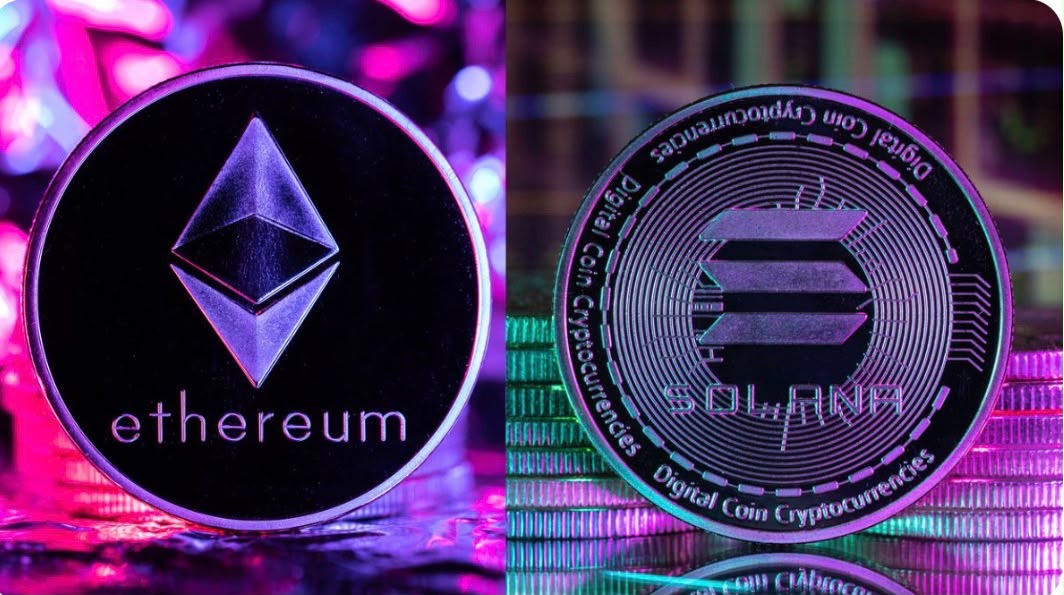
ETH and SOL are digital commodities priced through supply and demand, and both networks are now considering code changes that would cut annual inflation and therefore reduce future token supply. On the surface the price action is unremarkable: Ethereum trading around $1,876 and Solana around $75, with no clear bullish or bearish momentum dominating either asset and the RSI for both offering no definitive directional signal.
But while the charts are quiet, Zach Pandl, Head of Research at Grayscale, one of the world’s largest digital asset management companies, published an analysis this week that gives holders of both assets something considerably more interesting to think about than the current price.
The code changes being debated in the Ethereum and Solana ecosystems are designed to reduce how many new tokens enter circulation each year, and if implemented, Ethereum’s annual supply inflation could fall to roughly 0.4% by the end of 2031, placing it on par with Bitcoin’s projected supply growth, while Solana’s annual inflation would decline to approximately 1.1% over the same period.
Both figures would sit below gold’s estimated 1.8% annual supply growth and well under the 3.3% US consumer price index inflation rate, meaning that by 2031, if these proposals pass, ETH and SOL would be growing their supply more slowly than the world’s most established store of value, a comparison that carries significant weight in any conversation about long-term digital asset valuation.
To understand why this matters you need to understand what inflation means in the context of a cryptocurrency.
When new ETH or SOL is created and distributed as staking rewards, the total supply of those tokens expands, which dilutes the value of existing holdings in the same way that printing more money dilutes the purchasing power of the money already in circulation. The proposals under discussion on both networks aim to adjust staking rewards and token emission rates, which would directly reduce the rate at which new tokens enter the circulating supply, and the economic logic is straightforward: if demand stays constant or grows while the supply of new tokens entering the market slows, the existing tokens become relatively more scarce and basic supply-and-demand dynamics become more favourable for holders.
Pandl noted that lower supply growth could increase rarity, putting upward pressure on ETH and SOL prices, though he was careful to add that reduced supply does not guarantee higher prices since demand remains an entirely independent variable, and a cryptocurrency can have limited supply and still decline if demand falls.
The trade-off for stakers is real and worth understanding honestly.
A significant portion of ETH and SOL staking returns currently comes from new token issuances, and reducing token inflation would also reduce the rewards received by staking investors. A staker who earns five SOL today might receive three SOL after a reduction in inflation, and whether those three SOL are worth more than the original five depends entirely on whether the reduced supply actually drives the price appreciation the analysis predicts. Unstaked holders, by contrast, would benefit directly from any scarcity-driven repricing without experiencing the reduction in yield.
The specific proposals involved are Ethereum’s EIP-8361 and Solana’s SIMD-0550 and SIMD-0553, both of which remain under discussion and have not been implemented, meaning the projected inflation rates are not guaranteed and the forward-looking projections assume these proposals take effect immediately and that network activity remains fixed at recent levels.
Pandl noted that the Solana proposals appear to have broader community consensus and are therefore relatively more likely to be implemented than the Ethereum counterpart, which matters because community governance processes are genuinely unpredictable and the difference between a proposal with broad consensus and one without it can be the difference between a change that happens in 2026 and one that gets debated indefinitely without resolution.
What Grayscale’s analysis does, regardless of whether either proposal passes, is reframe the question serious investors should be asking about ETH and SOL, not just where the price is going next week but what the fundamental supply dynamics of these networks look like over a five-year horizon, and whether the structural changes being discussed represent a genuine shift in how these assets behave as stores of value or simply another round of community debate that produces no change.
The price is quiet today. The proposal that could make that price considerably louder by 2031 is being debated right now.
ETH and SOL are on Monica. When the market moves and you’re ready to act, convert your Ethereum or Solana to naira in seconds.
The time to know your platform is before you need it. Download Monica now 👉https://monica.cash/app