Hollywood’s Billion-Dollar Comeback Is Getting Hard to Ignore
From superheroes and animation to music biopics and ancient epics, 2026 is proving that audiences have not fallen out of love with the big-screen experience
Hollywood may have spent the past few years wondering whether audiences were permanently moving on from cinemas. The box office now has an answer.
Not quite yet.
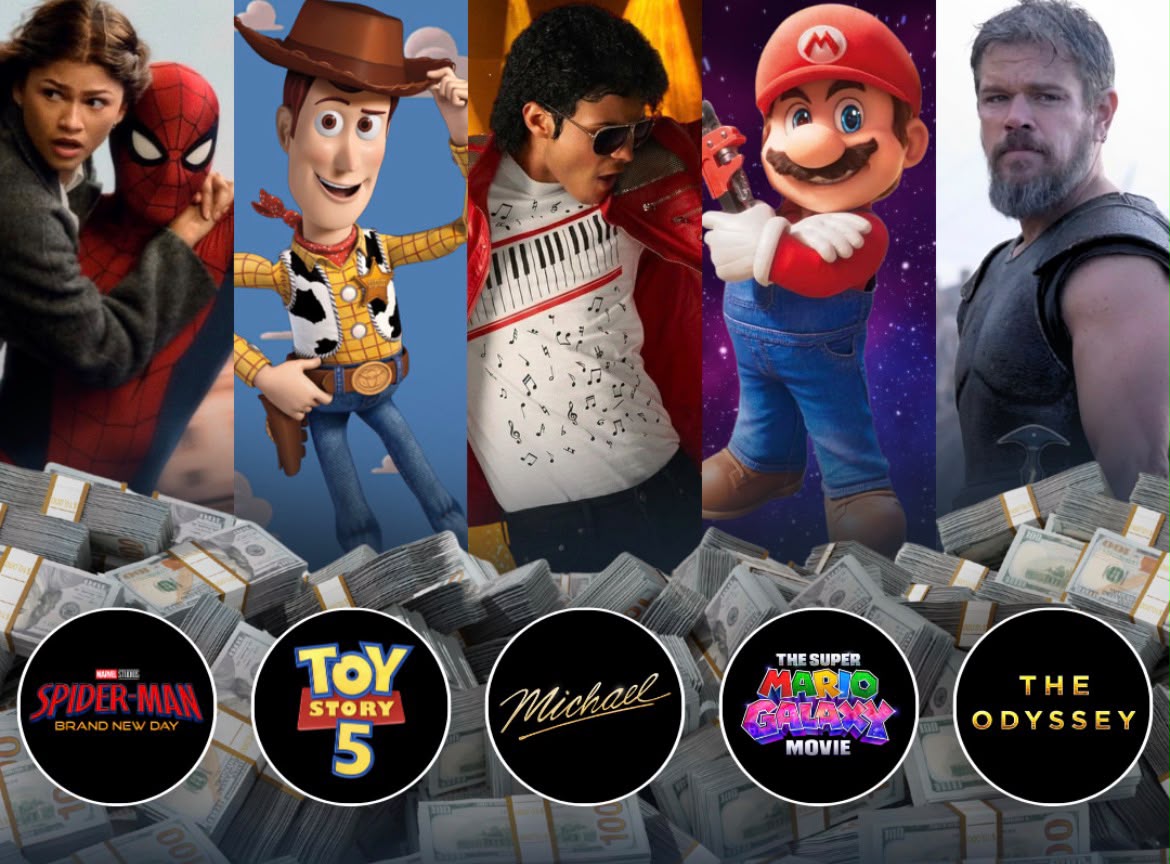
2026 has delivered a striking run of billion-dollar blockbusters, with films ranging from animated adventures and superhero spectacles to a Michael Jackson biopic and Christopher Nolan's adaptation of The Odyssey attracting audiences in numbers that would have seemed increasingly difficult to achieve after the pandemic.
And the biggest surprise may be that the billion-dollar club is no longer being dominated by just one kind of movie.
The year began with The Super Mario Galaxy Movie, which became the first film released in 2026 to cross $1 billion worldwide. Pixar's Toy Story 5 followed, while Michael, the biopic about Michael Jackson, also joined the club and became the first music biopic in history to reach the milestone.
Then came the superhero swing.
Spider-Man: Brand New Day has turned into one of the year's biggest theatrical stories, climbing to roughly $1.67 billion worldwide and passing $1 billion from international markets alone. Its performance has been particularly notable because it arrived at a time when Hollywood had spent years questioning whether superhero fatigue had finally caught up with audiences.
And the story did not stop there.
Christopher Nolan's The Odyssey has also crossed the billion-dollar threshold, becoming the director's highest-grossing film to date. The adaptation of Homer's ancient Greek epic has demonstrated that audiences can still turn out in huge numbers for an original theatrical spectacle that is not built around a superhero universe.
That variety is what makes this year's box-office recovery particularly interesting.
There is Mario, a character born from video games. There is Toy Story, a decades-old animated franchise. There is Michael, built around the life and music of one of the world's most recognisable performers. There is Spider-Man, one of cinema's most established superheroes. And then there is The Odyssey, a cinematic interpretation of a story that has survived for roughly 2,700 years.
Different audiences, Different genres, Different generations.
But the same destination: the cinema.
The big screen still has something phones cannot replace
The resurgence is not happening in isolation.
Movie theatres have increasingly leaned into premium experiences such as IMAX, Dolby Cinema, ScreenX and 4DX, allowing studios and exhibitors to turn major releases into events rather than simply another piece of content competing for attention on a screen at home.
That matters because the economics of the cinema have changed too.
Tickets cost considerably more than they did before the pandemic, while premium formats command an even higher price. So a blockbuster does not necessarily need to attract the same number of people it did years ago to generate the same level of revenue.
But price alone cannot explain everything.
People still have to decide that a film is worth leaving home for.
And millions apparently are.
The young audience Hollywood was worried about
One of the more interesting parts of the comeback is the role of younger moviegoers.
For years, Hollywood faced a worrying question: would a generation raised on TikTok, YouTube, streaming platforms and mobile entertainment still care enough about cinema to buy a ticket?
The evidence from 2026 suggests that the answer is more complicated than a simple yes or no.
Young audiences may consume more entertainment on their phones than previous generations, but that does not mean they have abandoned shared experiences.
When the film feels big enough, the audience can still show up.
Spider-Man: Brand New Day has provided a particularly strong example, with younger viewers forming a significant portion of its audience. Its performance suggests that the theatrical experience can still compete for attention when a film becomes a cultural event rather than merely another release.
And that may be the bigger lesson for Hollywood.
The problem was perhaps never that audiences stopped loving movies.
They became more selective about which movies were worth leaving the sofa for.
Hollywood is not completely back yet
There is still a reason for the industry to remain cautious.
The pandemic caused a major disruption to theatrical releases, production schedules and audience habits, and the industry has not simply returned to its 2019 position overnight.
But the billion-dollar performances are encouraging signs.
More importantly, they show that audiences are still willing to make cinema-going part of their entertainment routine when studios give them a compelling reason.
The success of Michael is particularly revealing. A musical biopic became the first film in that category to cross $1 billion globally, demonstrating that enormous theatrical success does not necessarily require a superhero costume or a computer-generated universe.
Meanwhile, The Odyssey has taken a very different route to the same destination, showing the commercial strength of large-scale filmmaking built around mythology, spectacle and a major director.
So perhaps the cinema's comeback is not really about Hollywood returning to the past.
It may be about Hollywood learning what the audience wants from the future.
A film has to feel big enough, exciting enough or culturally significant enough to make people put down their phones, leave the house, buy a ticket and sit beside strangers for two or three hours.
In 2026, audiences are proving that they are still willing to do exactly that.
Hollywood just has to keep giving them reasons.
And while the billion-dollar numbers make excellent headlines, the real victory may be happening much closer to the screen in packed theatres, shared reactions, loud laughter, surprised gasps and that familiar moment when the lights go down and everyone stops scrolling.
The cinema isn't dead. It simply had to remind us why we loved it in the first place.
And while Hollywood brings the stories to the big screen, Monica is making the everyday money moves behind the scenes easier. From converting crypto to naira to handling everyday payments and utilities, you can keep your finances moving while the entertainment keeps rolling.
Download Monica https://monica.cash/app and make your next money move your own blockbuster.